Welcome TESS followers to our latest news bulletin!
This week, we are looking at three recent papers from the archive. Enjoy, and happy holidays!
First is a double feature highlighting the precovery observations from TESS of 3I/ATLAS– the third known interstellar object passing through the Solar system. These objects represent an extraordinary opportunity to study extrasolar bodies ‘in-situ’, offering deeper insights into planetary formation processes occurring throughout our Galaxy. 3I/ATLAS provides crucial information for better understanding the composition and dynamical evolution of these cosmic wanderers that may otherwise remain inaccessible for the foreseeable future.
Next, we outline a paper reporting the discovery of an unusual quasi-periodic pulsation in the mid-M dwarf star GJ 3512, representing the first detection of such a sustained oscillatory signal in a late-type star. Unlike typical stellar quasi-periodic pulsations that occur only during individual flares and last minutes to hours, this signal persists for weeks and recurs across multiple observation periods spanning nearly three years. This finding has important implications for understanding magnetic activity, coronal heating, and energy release mechanisms in the most common stars in our galaxy.
The third paper reports a detailed study of WASP-189 b, an ultra-hot Jupiter orbiting a rapidly rotating A-type star, representing an important class of exoplanets with atmospheric properties distinct from cooler hot Jupiters. Understanding these rather extreme worlds helps trace how planetary atmospheres behave under intense stellar radiation and provides insights into atmospheric chemistry, heat transport, and orbital dynamics in extreme environments.
Precovery Observations of 3I/ATLAS from TESS Suggests Possible Distant Activity (Feinstein et al. 2025) : Pre-discovery TESS Observations of Interstellar Object 3I/ATLAS (Martinez-Palomera et al. 2025) :
Feinstein et al. (2025) and Martinez-Palomera et al. (2025) present independent precovery observations of 3I/ATLAS captured by TESS between May 7 and June 2, 2025 (Sector 92), almost two months before its official discovery. During the ~26-day observation period, 3I/ATLAS covered a distance of ~1 AU, from approximately 6.4 to 5.5 AU from the Sun. To obtain photometric measurements from the Full-Frame Images, and search for variability that could reveal information about the object's rotation, shape, and possible cometary activity, the research teams employed sophisticated custom extraction techniques that accounted for the object's rapid motion across the field of view. Each group successfully recovered the object with high statistical confidence, detecting the target’s signal in both Camera 2 CCD 3 and Camera 1 CCD 2, the latter being stronger. Feinstein et al. (2025) validated their methodology by successfully recovering the known asteroid 896 Sphinx, demonstrating their technique's reliability for detecting faint moving objects. Palomera-Martinez et al. (2025) developed position refinement techniques because they found offsets between the JPL Horizons ephemeris predictions and the actual measured positions on the detector ranging from ~2 to ~13 arcseconds, depending on the camera-CCD combination and coordinate direction. The observations revealed that the corresponding TESS magnitude decreased from ~20.9-20.8 (Camera 2 CCD 3) to ~19.6-19.3 (Camera 1 CCD 2) for Martinez-Palomera et al. (2025) and Feinstein et al. (2025), respectively, corresponding to absolute visual magnitudes of ~14.3-13.7 to ~13.7-12.5 for. Both teams investigated the data for periodic brightness variations that could reveal rotation periods or other time-variable phenomena. Feinstein et al. (2025) identified a ~16-hour periodic signal in the lightcurve extracted from Camera 1 CCD 2, found no statistically-significant evidence for a rotation signal from the comet nucleus, and note that target brightened more than expected given its trajectory, suggesting outgassing. Martinez-Palomera et al. (2025) found indications of early, weak cometary activity, noting that it is consistent with recent reports of dust outflows at a distance of ~9 AU. Thanks to TESS, the authors were able to extract observations of 3I/ATLAS, the third known interstellar interloper crossing the Solar system, more than a month before the object was officially announced. Their analysis showed that the object was likely already exhibiting weak activity at a heliocentric distance of about 6 AU, with the corresponding brightness consistent with that of a R < 3 km nucleus as suggested by HST observations.
A recurrent 70-100 minute quasi-periodic pulsation in the intermediate-aged mid-M dwarf GJ 3512 (Lopez-Santiago et al. 2025) :
Lopez-Santiago et al. (2025) report the discovery of a recurring, persistent quasi-periodic pulsation in the M-dwarf GJ 3512. TESS observed GJ 3512 in Sectors 20, 47, and 60 at 2-min cadence, where the star showed a rotation period of about 84 days. The target is classified as an intermediate-aged main sequence star with an estimated age between 2 and 8 Gyr and a spectral type of M5.5V. The star hosts two confirmed exoplanets with orbital period of ~200 days and 1,600 days, and exhibits a rotation period of ~84 days based on photometric measurements. During the observations, the star displayed frequent flaring activity with approximately one flare per day on average and more intense flares occurring roughly every two days. The authors performed a detailed wavelet analysis on the available data and identified a strong oscillatory signal with a period varying between 70 and 100 minutes that appeared consistently across these observations. The detected signal shows a modest amplitude of approximately 1 to 2 mmag and remains coherent throughout the observation window of each sector. Statistical analysis using surrogate data tests confirmed the signal's significance at better than the 99.9% confidence level. The authors ruled out several possible explanations for the observed oscillations, including instrumental artifacts. Specifically, Lopez-Santiago et al. (2025) argue that stellar pulsations can be excluded because theoretical instability strips that might produce oscillations with ~10-min periods are restricted to pre-main sequence stars, whereas GJ 3512 is firmly on the main sequence. Additionally, the stellar rotation period is far too long to explain the signal, and star-planet magnetic interactions are unlikely because the inner planet’s pericenter is larger (~0.19 AU) than the distance where such interactions are expected to become significant. The authors argue that most plausible interpretation involves magnetohydrodynamic oscillations occurring in long-lived coronal structures and suggest that the signal originates from either oscillatory magnetic reconnection or thermal cycling in large-scale coronal loops. Lopez-Santiago et al. (2025) note that the persistence of the signal across years suggests the presence of stable or regularly recurring active regions capable of hosting extended magnetic loop systems, and indicates continuous microflaring activity and reconnection-driven oscillations. Capitalizing on TESS data, the authors were able to detect, for the first time, sustained quasi-periodic pulsation in the late-type M-dwarf GJ 3512, providing evidence that these stars can support long-lived coronal oscillations.
TESS phase curve of ultra-hot Jupiter WASP-189 b (Patel et al. 2025) :
Patel et al. (2025) investigated the atmospheric properties and orbital architecture of the ultra-hot Jupiter WASP-189 b, combining data from TESS and CHEOPS. With an orbital period of only ~2.7 days around an A-type stellar host with an effective temperature of ~8,000K, WASP-189 b has an equilibrium temperature of 3,353 K, making it one of the hottest exoplanets known. The host star WASP-189 rotates rapidly with a period of just 1.22 days and is significantly oblate due to centrifugal forces, causing its equator to appear darker than its poles through gravity darkening. The authors confirmed that the planet is on a polar orbit, with a spin-orbit angle of about 89.5 degrees, and found no indications of fast orbital precession on observable timescales. Patel et al. (2025) report that the TESS observations reveals a phase curve with an occultation depth of 203.4 parts per million, indicating substantial dayside emission, while the nightside flux is consistent with zero within measurement uncertainties, with a negligible offset. By inverting the phase curve signal, the authors constructed temperature maps showing the planet's atmosphere reaches approximately 2,746 K on the dayside while the nightside remains around 1,529 K. Patel et al. (2025) note that the corresponding ~1,000 K temperature difference between the substellar point and the morning-evening terminator suggest inefficient heat transport. The authors estimate a median Bond albedo between 0.19 and 0.35 in the TESS bandpass and between 0.05 and 0.19 in the CHEOPS bandpass, and constrained the heat redistribution efficiency to a median range of 0.09 to 0.41, indicating that very little energy absorbed on the dayside is transported to the nightside. Their atmospheric modeling suggests the dayside emission in both TESS and CHEOPS bandpasses is dominated by thermal radiation rather than reflected starlight, and the corresponding heat transport is highly inefficient. Thanks to TESS, Patel et al. (2025) were able to investigate the thermal structure of the ultra-hot Jupiter WASP-189 b, detect a ~200 ppm occultation in the prominent phase curve, and constrain the dayside emission of the planet.
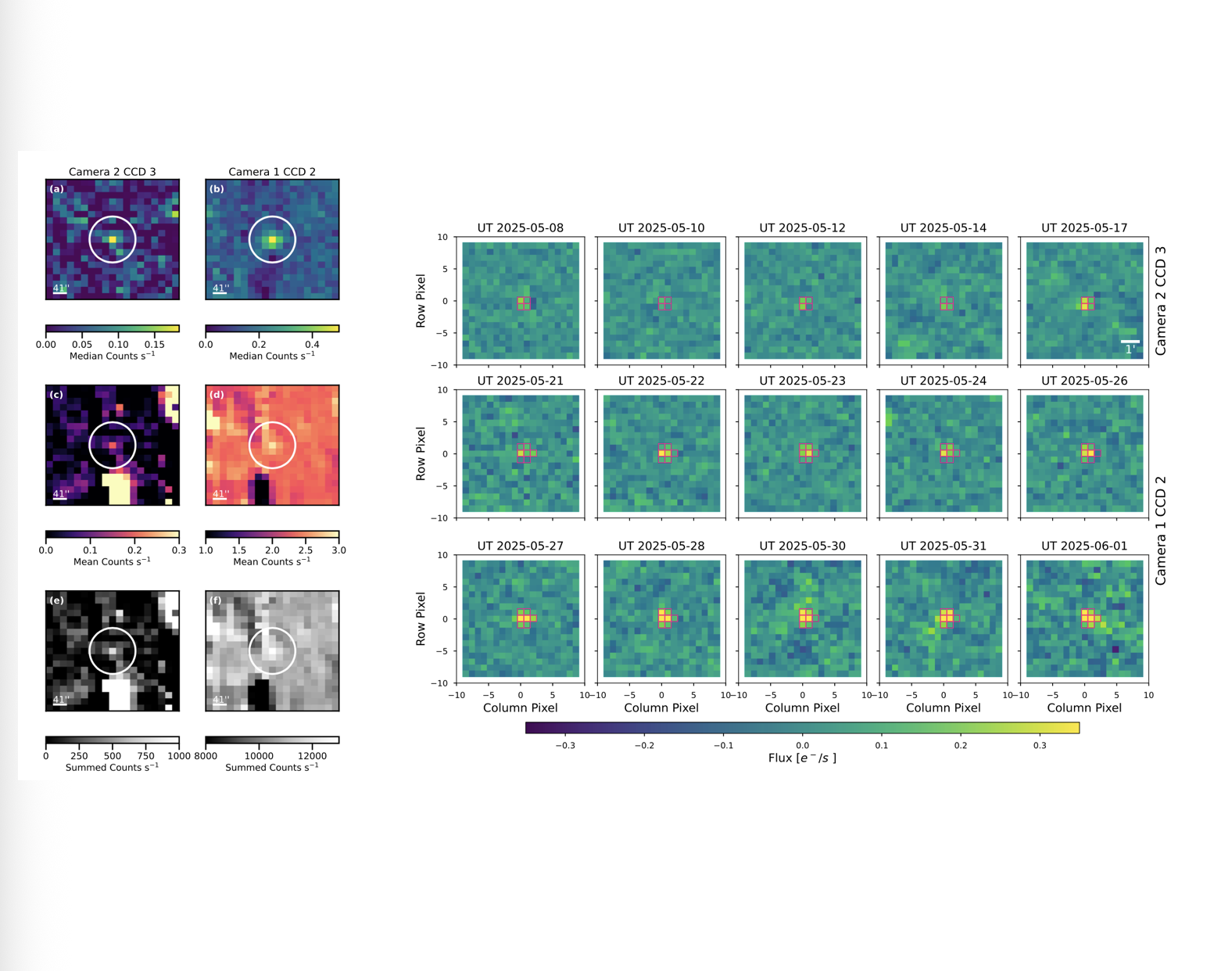
Fig. 1: Taken from Feinstein et al. (2025) and Palomera-Martinez et al. (2025). Left: Stacked TESS images of 3I/ATLAS from Feinstein et al. (2025) from the two CCDs. The upper/middle/lower panels represent the corresponding median/mean/summed images. Right: Same as left but from Palomera-Martinez et al. (2025). The red contours represent the corresponding apertures used to extract the photometry.
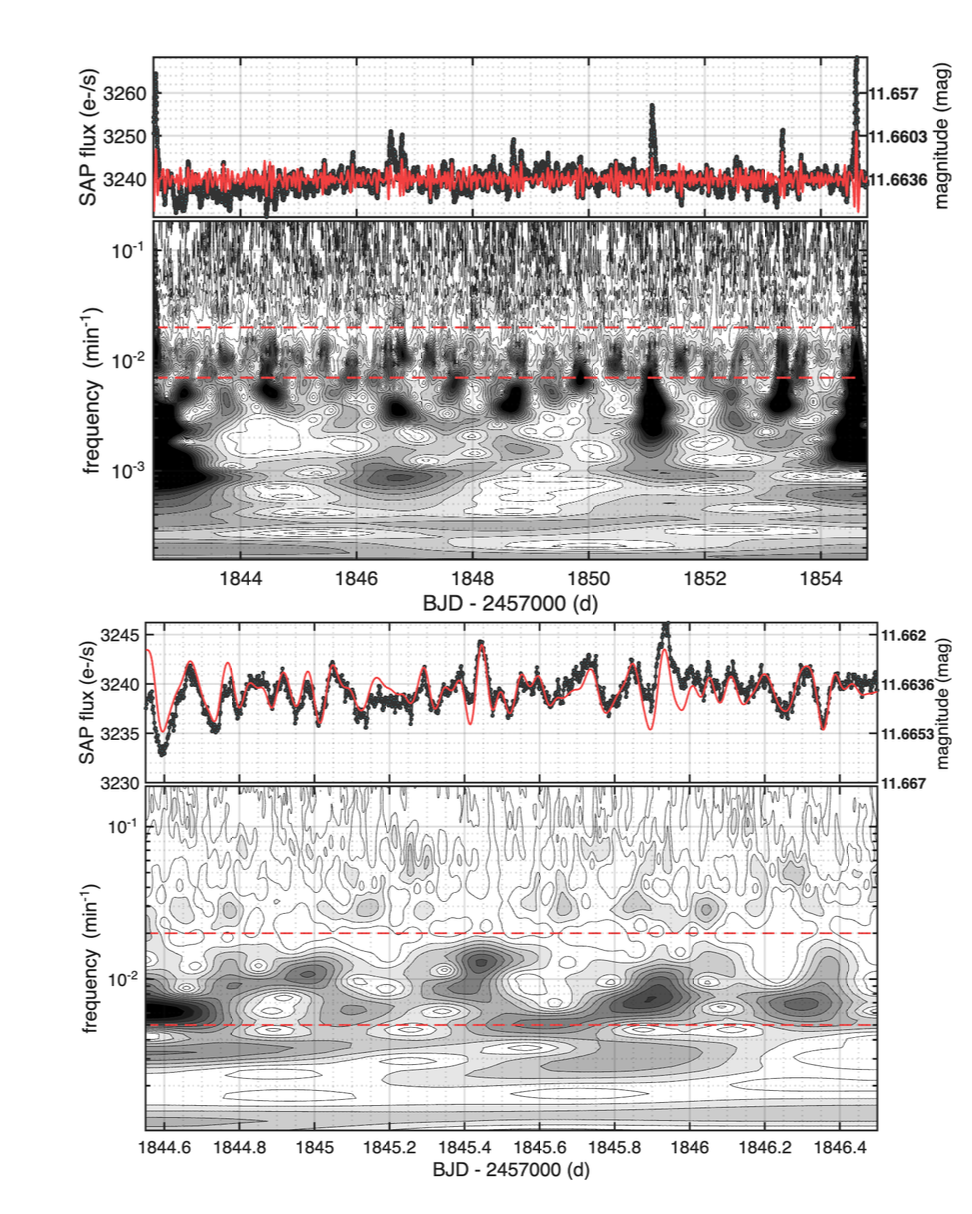
Fig. 2: Taken from Lopez-Santiago et al. (2025). Upper panels: Scalogram for 13 days of TESS observations of GJ 3512. Lower panels: Same as upper panels, zoomed in on 2 days of data to highlight the detected quasi-periodic pulsation.
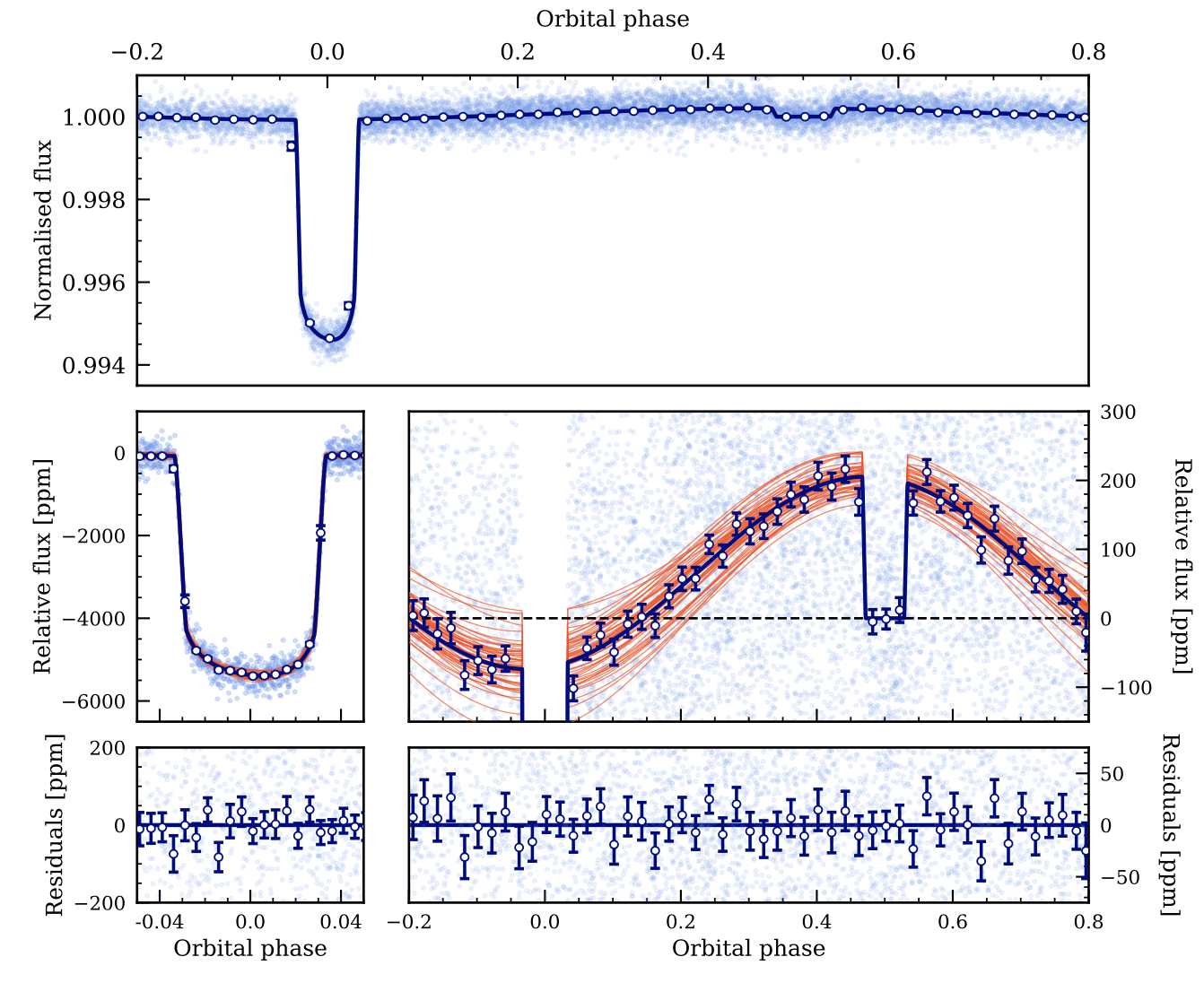
Fig. 3: Taken from Patel et al. (2025). Phase-folded TESS lightcurve of the ultra-hot Jupiter WASP-189 b, along with the corresponding best-fit model. The middle right panel highlights the prominent phase curve and occultation.