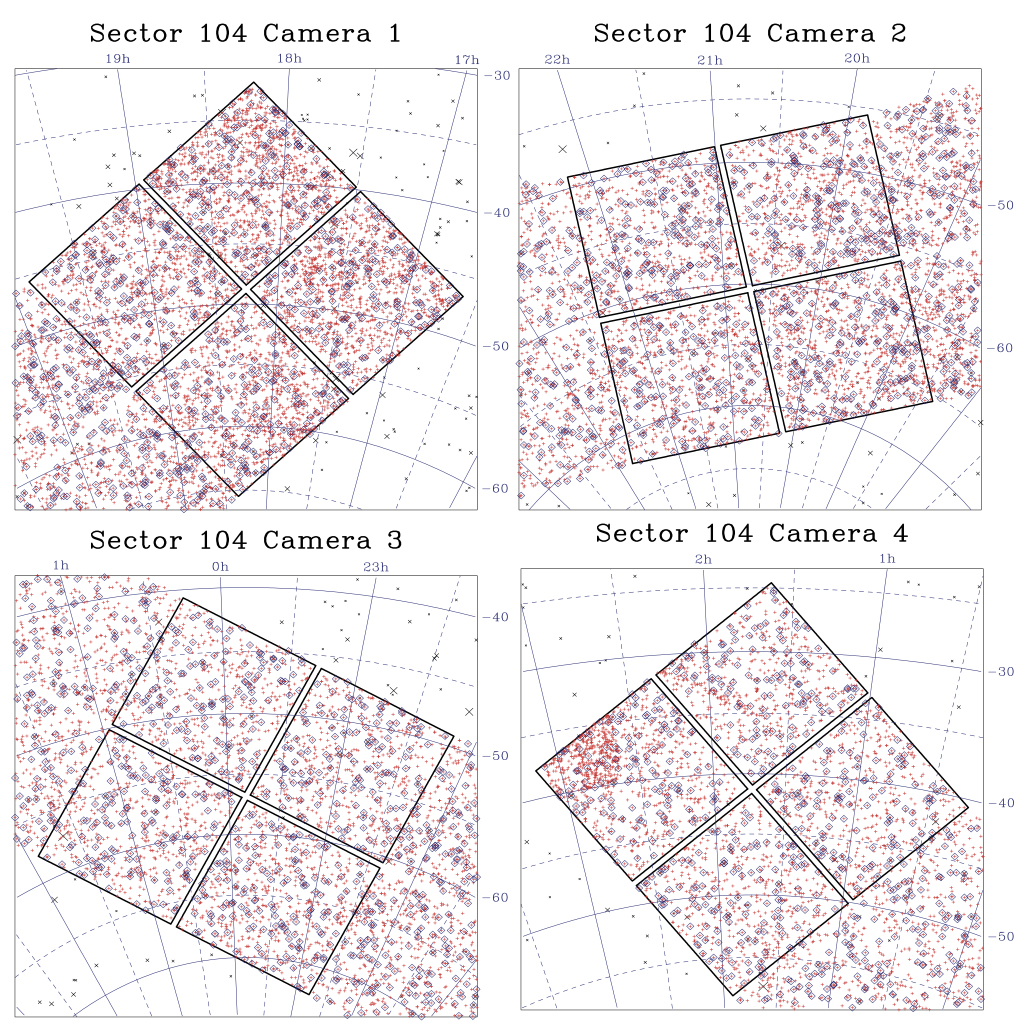
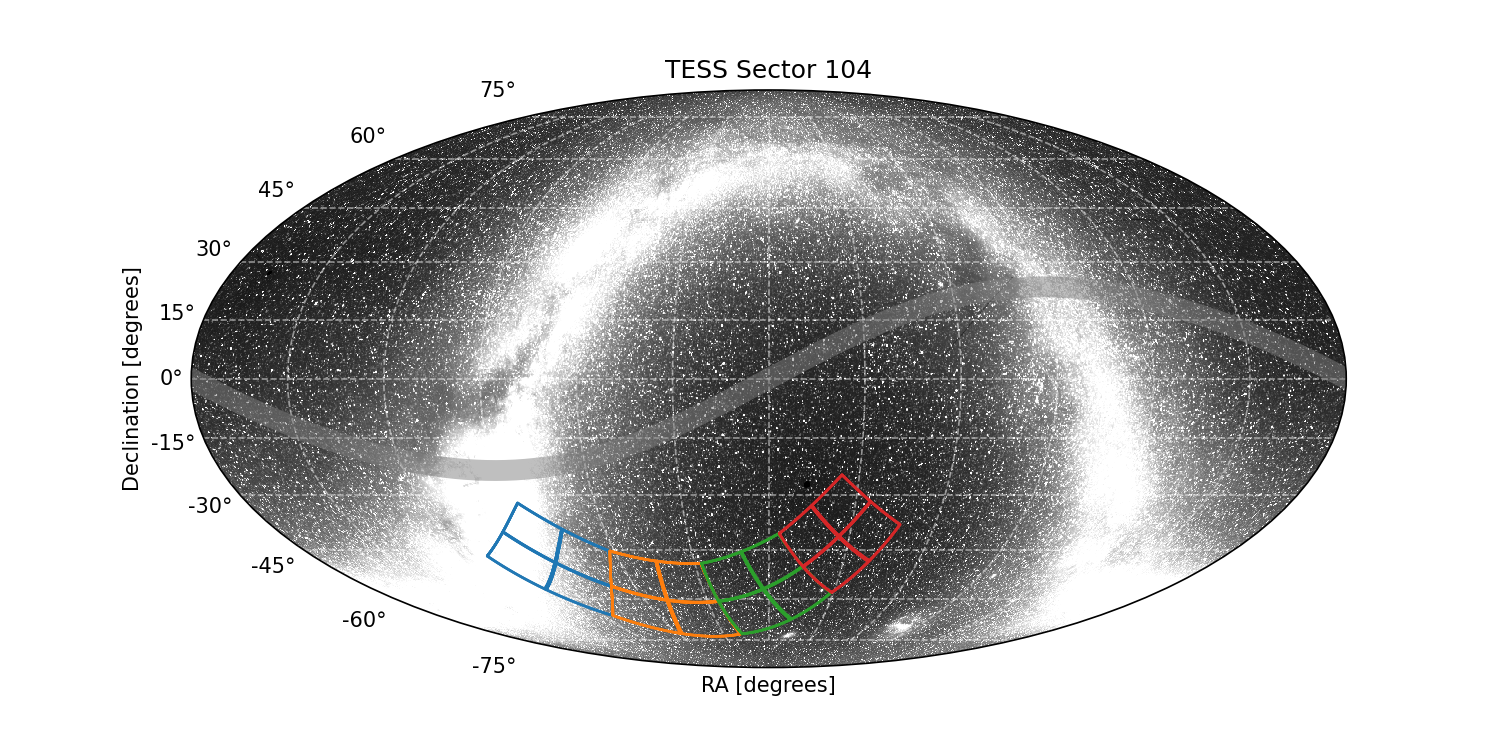
Sector 104
Sector 104 Information
For full data release notes see: DRN142.
For a list of TIC IDs with noted issues, see this list.
Sector Summary
Sector dates: May 17 to Jun 13 2026
Pointing: Southern hemisphere
Days of Science Data Collection: 25.99
Days of Paused Data Collection: 0.63
Spacecraft Pointing (deg)
|
RA |
dec |
roll |
| Spacecraft |
335.46 |
-60.75 |
279.24 |
| Camera 1 |
273.80 |
-48.76 |
317.02 |
| Camera 2 |
310.89 |
-60.43 |
347.75 |
| Camera 3 |
357.50 |
-56.84 |
208.16 |
| Camera 4 |
26.00 |
-41.28 |
230.08 |
Sector Notes
| Noted Issue |
Description |
| Engineering Tests: |
During the second half of orbit 220, a test of a new spacecraft attitude control system,
ACS 5.11, was conducted. The test included three reaction-wheel calibration episodes, which
resulted in large dispersions in the spacecraft pointing. The calibrations
took place between TJD 4198.61-4198.72, 4200.81-4200.91, and 4203.00-4203.11. The as-
sociated cadences were processed by the pipeline with some caveats.
The reaction-wheel calibrations were performed to evaluate the performance of
ACS 5.11; they are not required for the nominal operation of ACS 5.11. |
| Rolled Sector: |
Sector 104 is the sixth of 9 overlapping “rolled” sectors that provide extended
temporal coverage of the southern ecliptic’s mid-latitudes. This observing plan is designed to
detect longer period planets than typical TESS pointings at latitudes that are more amenable
to follow up observations.
|
| Spacecraft pointing: |
The pointing in Sector 104 was set at−46.0 degrees in ecliptic latitude. The instrument field-
of-view was rotated by∼ 40◦ covering a region of southern ecliptic mid-latitudes. Camera 1
was used for guiding in half-orbit segments 219a and 220a. Camera 4 was also used for
guiding in half-orbit segments 219b, 220a and 220b. |
| Scattered light: |
In Sector 104, the Earth introduces scattered light signals in all cameras near the beginning of orbits 219a and 220a and end of orbit 219b and 220b. The moon also affects Cameras 1 and 2 at the beginning of orbit 220b
|